
Split solar street lights
LS-S80 80 W split solar street light kit
- 80 W nominal LED head
- LiFePO4 12.8 V · 50–70 Ah · 640–896 Wh
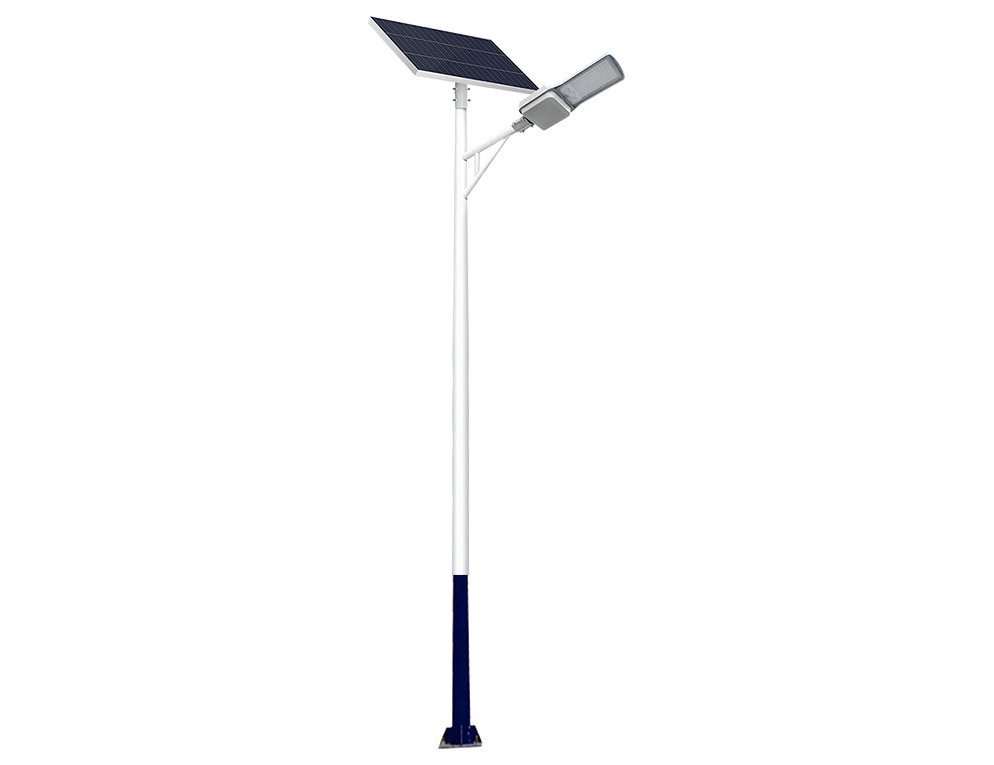
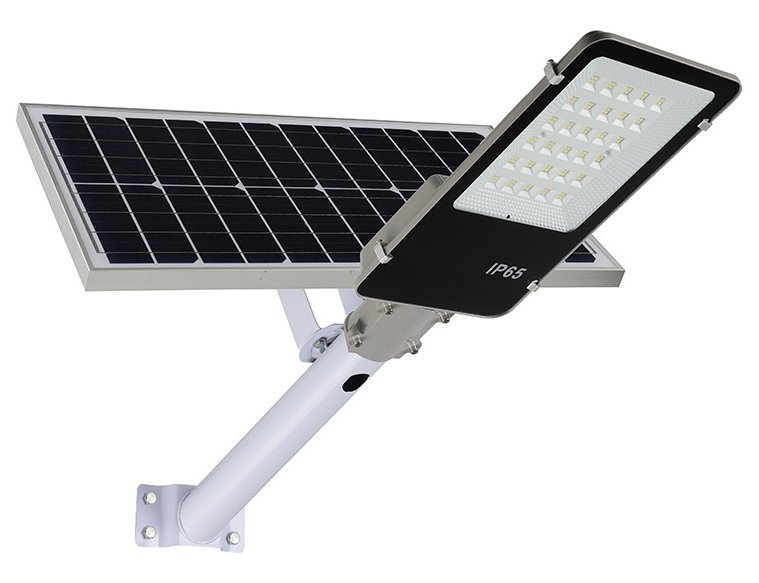
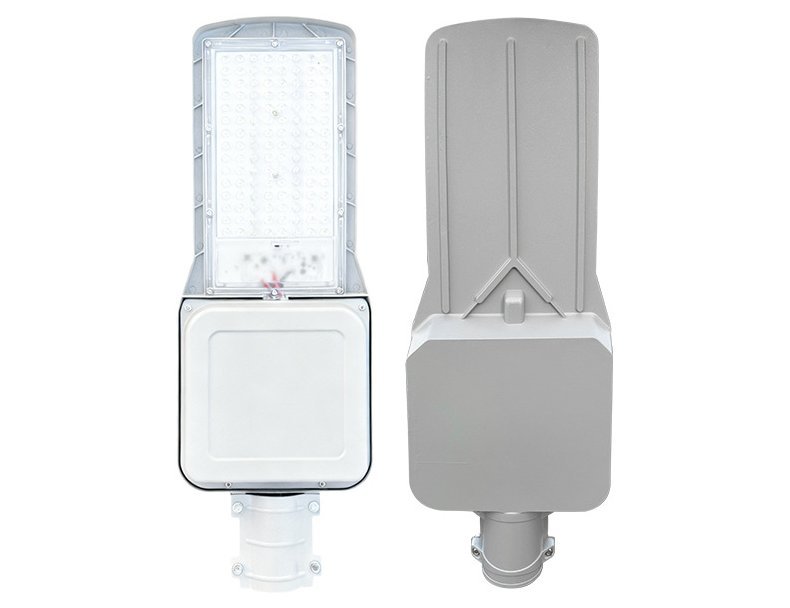
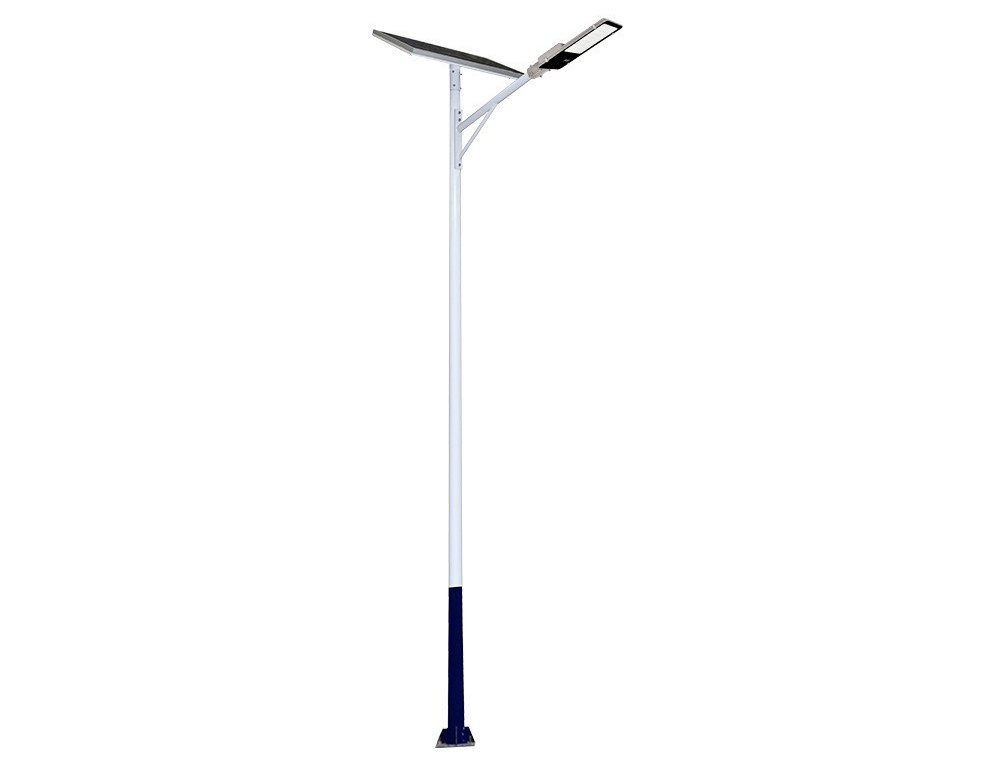
50–60 W LED head · separate 80–120 Wp tilted panel · LiFePO4 12.8 V 30–50 Ah (384–640 Wh) · 5–6 m Moroccan pole
The LS-S60 60 W split solar street light with pole and battery is an off-grid stand-alone kit in three parts: a 50 to 60 W nominal LED head (180–220 lm/W), a separate 80 to 120 Wp panel on a tilt bracket and a LiFePO4 12.8 V battery of 30 to 50 Ah (384 to 640 Wh) housed at the top of the pole or in a buried box, on a 5 to 6 m hot-dip galvanised conical pole made in Morocco. It is the kit for rural roads, village programmes and PRDTS projects in Morocco (indicative class M6 or P4–P5, NM EN 13201). Autonomy up to 12 h per night with 3 days of reserve, sized per site; price for Morocco on request (quote via WhatsApp).
How is it sized? Unlike an all-in-one, every element is chosen: 80 or 120 Wp of panel, 30 or 50 Ah of battery (12 Ah economy version, ≈ 154 Wh, for a path on motion detection only), 50 or 60 W of head. The luminous flux of the chosen configuration is given by its IES file, supplied with the quote. The head's nominal power is not its average draw: the MPPT controller applies a dimming profile and the PIR sensor raises the flux on movement; the panel tilted at 32° harvests +62 to +68 % more energy in December than a flat panel, which allows a constant reduced flux all night.
In a buried box at the pole base the battery stays away from the heat and is replaced without a lift; at the top of the pole it stays separate from the LED head. The separate panel is cleaned and oriented due south. The pole is Moroccan-made (25 % safeguard duty on imported poles, HS 7308.90.10): LALOGO supplies the 5.7 or 6 m LS-P6 pole drawing to the local fabricator and delivers the head, panel, LS-B bracket, battery and cabling. IP66 coastal version with marine-grade coating for coastal villages.
| Element | Typical configuration |
|---|---|
| PV module | Separate · 80 or 120 Wp · LS-B tilt bracket 15–45° |
| Battery | LiFePO4 12.8 V · 30 or 50 Ah · 384 or 640 Wh (economy version: 12 Ah ≈ 154 Wh) · pole-base box |
| LED module | 50 or 60 W nominal head |
| Luminous efficacy | 180–220 lm/W · flux: see IES file |
| Beam angle | Road distribution · see IES file |
| Colour temperature (CCT) | 3000 K, 4000 K or 6500 K |
| Operating temperature | −20 °C to +65 °C |
| IP / IK | Specified by the client (NM 06.8.001 §7) · recommended: IP65 inland, IP66 coastal |
| Housing | Die-cast aluminium head · hot-dip galvanised bracket |
| Dimensions | Per configuration |
| Weight | Per configuration |
| Mounting | 5–6 m conical Q235 hot-dip galvanised pole, made in Morocco (LS-P6 drawing) · single arm |
| Controls | MPPT · PIR · dusk-to-dawn sensor · programmable profile |
| Charge time | Depends on the Wp and Ah chosen |
| Autonomy | Up to 12 h per night · 3 days of reserve · sized per site |
Typical configuration of a configurable kit: final sizing (Wp, Ah, pole height, spacing, profile) is done per site from December irradiation and the target NM EN 13201 class, then confirmed on the quotation with the IES file.
Parameters refer to standard versions at 25 °C and may be updated without notice — please confirm them in the technical offer.
Sized for December with a panel tilted at 32° facing south: in Casablanca the tilted plane receives 4.93 kWh/m²/day versus 2.99 flat (PVGIS-SARAH2 2005-2020, JRC); in Tangier 4.32; in Ouarzazate 6.37. With a system efficiency of 0.72 (engineering assumption), a 120 Wp panel harvests 120 × 4.93 × 0.72 ≈ 426 Wh per day in Casablanca, ≈ 373 Wh in Tangier and ≈ 550 Wh in Ouarzazate; an 80 Wp panel, ≈ 284 Wh in Casablanca. The night of 21 December lasts ≈ 14.1 h in Casablanca (astronomical computation): a 60 W head held at 40 % flux draws about 24 W × 14.1 h ≈ 338 Wh, which the 120 Wp panel covers in December in Casablanca, with the PIR raising it to 100 % on movement.
The battery sets the reserve: the test condition of the NM 06.8.001 draft (16 h continuous at ≥ 40 % flux, 25 °C) corresponds, for a 60 W head, to about 60 × 0.4 × 16 ≈ 384 Wh. That is why we recommend the 50 Ah battery (640 Wh) on village roads, the 30 Ah (384 Wh) on lightly used paths and the 12 Ah economy version (≈ 154 Wh) only for motion-triggered lighting. Autonomy depends on irradiation (sized for December) and on the dimming profile; in June the tilted plane harvests about as much as the horizontal one (7.5 kWh/m²/day) for a 9.4 to 10.1 h night.
The LS-S60 kit is designed to IEC 60598-1 and IEC 60598-2-3 (head), IEC 62717 (LED modules), IEC 60529 (IP) and IEC 62133-2 (LiFePO4 battery); the panel follows the IEC 61215 and IEC 61730 series cited in the NM 06.8.001 draft. NM 06.8.001 file in progress: the standard requires ≥ 130 lm/W, 0–100 % dimming with astronomical clock, a 16 h autonomy test at ≥ 40 % flux, a panel lower edge ≥ 3 m above ground, and allows the battery at the pole base or in the foundation. Cم marking (law 24-09, orders 2573-14 and 2574-14) with a declaration of conformity and an Arabic manual.
The pole is Moroccan-made (25 % safeguard duty on imported poles, HS 7308.90.10); the customs classification of the luminaire is confirmed by our customs broker. For a rural commune, AREP or PRDTS specification we supply the FR/EN datasheet, IES/LDT files for the NM EN 13201 study (indicative class M6 or P4–P5 for a village road), the LS-P6 pole drawing to NM EN 40-5 and NM ISO 1461, and the EN/NM correspondence table.
Send the quantity, the city and any pole or mounting details — we will reply with a technical and commercial offer including delivery to Morocco.
Last updated: 23 September 2026


